What if the biggest opportunity to grow your CPA firm isn’t bringing in another client?
Think about how much effort goes into business development.
Building referral relationships. Scheduling discovery calls. Preparing proposals. Winning new engagements.
Now think about what happens after a prospective client says yes.
Tax organizers go uncompleted. Source documents remain outstanding. Staff members spend hours on work that wasn’t included in the engagement letter. Partners get pulled into routine questions, and potentially valuable tax planning conversations never happen.
Meanwhile, your team is working harder than ever.
The calendar is full. Deadlines are approaching. Everyone is busy.
But how much of that effort is actually translating into revenue?
A full pipeline and a busy staff don’t always translate into a more profitable practice.
Sometimes the biggest opportunity isn’t adding more clients. It’s improving how your firm manages the clients and engagements already on its books.
I recently experienced something that brought this problem into focus.
I Was the Client Who Almost Slipped Through the Cracks
In October, I met with a CPA firm to discuss services for my business.
The initial consultation went well. We discussed my needs, the scope of services, and what the firm would require before moving forward.
Like most new clients, I left with homework.
Prior-year tax returns. A profit and loss statement. Balance sheet. General ledger. A signed agreement.
Nothing unusual for a new business tax engagement.
Then life happened.
I got sick, traveled, and became busy running my company. Before I knew it, almost a month had passed.
I hadn’t uploaded the requested documents.
What surprised me was that nobody followed up.
No reminder about the outstanding financial records.
No message checking whether I needed help completing the onboarding requirements.
No update explaining what was holding up the engagement.
Eventually, I remembered that I still needed assistance with my R&D tax credits and reached back out.
But the experience stayed with me.
The firm had already spent time on the initial consultation and determining how it could help. There was a legitimate need for services and a prospective client ready to move forward.
Yet the engagement sat in limbo because of missing documents.
As someone who builds AI-powered operational systems, I immediately recognized the issue.
The accountant’s technical expertise wasn’t the problem.
The firm had a gap in its client onboarding and follow-up process.
And I started wondering how many other prospective clients were sitting in the same position.
How many signed engagement letters were outstanding?
How many tax organizers hadn’t been completed?
How many engagements were waiting on client documents with no clear next follow-up date?
These are everyday challenges in public accounting.
But when firms don’t have visibility into them, they can affect capacity, turnaround times, billing, and ultimately profitability.
Your Realization Reports Are Only Part of the Story
Most CPA firm owners pay close attention to revenue, billable hours, realization, and collections.
Those metrics tell an important story about practice performance.
But I think firms can gain even more insight by looking at what happens before those numbers reach the financial reports.
Consider billing realization.
Your team records time against an engagement, but not all that time ultimately makes it onto the client’s invoice.
Some of it gets written down because the work exceeded the original budget.
Some of it reflects inefficiencies or rework.
Other time might represent additional services that were never properly scoped or discussed with the client.
Collection realization tells another part of the story: how much of the amount billed the firm ultimately collects.
Then there’s WIP, the work performed but not yet billed, and accounts receivable, the invoices waiting to be paid.
Each metric matters.
But here’s the question I would encourage managing partners to consider:
What happened during the engagement that contributed to those results?
A client may have delayed providing source documents.
A staff accountant may have performed additional work without approval.
An engagement may have exceeded its budget because the scope changed.
Or an invoice may have sat in A/R longer than expected because billing follow-up wasn’t consistent.
These issues often become visible in financial reports after the underlying problem has occurred.
That’s why I believe CPA firms should pay closer attention to four operational indicators.
Four Numbers Every CPA Firm Owner Should Know
1. How many engagements are stalled waiting on client information?
Every tax professional knows the frustration of an incomplete client file.
You’re ready to move forward with a return, but you’re missing a Schedule K-1.
The client hasn’t uploaded the prior-year return.
A bank statement or general ledger is outstanding.
The tax organizer is incomplete.
Now the preparer has to stop, move to another engagement, and return to the original file later.
That creates additional coordination and potentially disrupts the firm’s preparation and review schedule.
I would start by tracking the number of open engagements awaiting client information and the average number of days each remains on hold.
Create a simple aging report for outstanding client requests.
Flag engagements that have been waiting more than 14 days as a starting point, while using shorter intervals for time-sensitive filing deadlines.
Review the list weekly.
You want to know which engagements are ready to move forward, which are waiting on clients, and who owns the next follow-up.
This can also help your team identify returns at risk of requiring an extension because necessary information is still outstanding.
The benefit is better control of your engagement workflow and fewer surprises as deadlines approach.
2. How much out-of-scope work is your firm absorbing?
Let’s talk about scope creep.
It’s something nearly every professional service firm encounters.
A client sends a quick email about an IRS notice.
Another asks for help with a payroll issue.
Someone wants advice about purchasing equipment or setting up another entity.
These requests might be perfectly reasonable, but they aren’t necessarily covered under the existing engagement letter.
And because your team wants to maintain strong client relationships, someone often handles the request without addressing the additional scope.
Over time, those seemingly small favors add up.
Here’s an illustrative example.
Suppose your firm handles 10 out-of-scope requests each week.
Each request averages 30 minutes of professional time.
Your average billing rate for that work is $200 per hour.
10 requests × 0.5 hours × $200 × 48 weeks = $48,000 annually.
That’s $48,000 worth of professional time at your firm’s normal billing rate.
It isn’t necessarily $48,000 in lost revenue. Some of that work may have been intentionally complimentary, and some clients might not have authorized an additional fee.
Still, it represents a meaningful amount of capacity.
And here’s something else worth considering.
Untracked scope creep doesn’t just affect this year’s realization. It can lead to underpricing next year’s engagements.
When you renew a client’s engagement, how accurately does the fee reflect the amount of work your team actually performed?
Without reliable time and scope data, you’re making that decision with incomplete information.
I would recommend tracking out-of-scope requests for 30 days.
Record the type of request, time spent, staff member involved, and whether the firm issued an additional fee quote or engagement letter amendment.
That information can inform your pricing, engagement budgeting, and staff capacity planning.
3. How many tax planning and advisory opportunities are you missing?
Your clients’ financial information can reveal opportunities to provide more value.
A business experiences substantial revenue growth.
A client forms another entity.
A company hires its first employees.
An owner begins thinking about retirement.
A business makes a significant capital investment.
Each situation may warrant a conversation about tax planning, entity structure, retirement planning, or other advisory services.
For firms expanding into Client Advisory Services (CAS), these are particularly important opportunities to recognize.
But someone needs to connect the information in the client’s records with a potential advisory need.
That doesn’t always happen during a busy tax season.
Preparers are focused on completing returns. Reviewers are clearing review notes. Partners are managing deadlines.
A planning opportunity can easily get buried in the compliance workflow.
Here’s what I would track:
The number of client events flagged for advisory review compared with the number of planning conversations actually completed.
Start with a short list of triggers your staff can recognize.
A meaningful year-over-year revenue increase, a newly formed entity, significant hiring, or a major asset purchase could prompt a partner review.
These events don’t automatically indicate that a specific tax strategy is appropriate. They signal that a professional conversation may be worthwhile.
Imagine identifying 15 clients with meaningful business changes during the quarter but discovering that only four had a planning conversation.
That’s 11 situations worth reviewing.
Not all will result in additional billable work.
But some may uncover valuable planning opportunities, while others strengthen the client relationship.
Either outcome is worth understanding.
4. How much partner time is lost to operational bottlenecks?
Think about how frequently your staff needs help locating information or clarifying firm procedures.
“Where’s the workpaper template?”
“Who reviews this type of return?”
“What’s our process for handling this notice?”
“What did we do for this client last year?”
These questions are part of managing an accounting practice.
But when the same questions repeatedly land on a partner’s desk, they can become a significant operational bottleneck.
The issue often isn’t that the staff lacks capability.
It’s that the firm’s processes and institutional knowledge aren’t documented or easily accessible.
Consider what happens when a senior accountant needs to interrupt a tax partner to answer a routine workflow question.
The senior accountant stops working.
The partner stops working.
And both must regain their focus afterward.
I would track recurring operational interruptions for two days.
Look for patterns rather than trying to assign a dollar value to every question.
The questions that repeatedly come up are good candidates for clearer SOPs, standardized templates, or an internal knowledge resource.
Your partners should spend more time on review, client relationships, complex tax matters, and advisory work.
Routine questions shouldn’t consume more of that capacity than necessary.
The 30-Minute Realization Snapshot
You don’t need new software to start investigating these issues.
You need 30 minutes, access to your practice management system, and a willingness to look closely at how work moves through your firm.
I call this exercise the Realization Snapshot.
It’s a quick operational review designed to identify where engagements and potential revenue may be getting stuck.
First 20 minutes: Review your open engagements
Pull a list of active engagements that are awaiting client information or another required action.
For each file, record the outstanding item, days waiting, last follow-up date, responsible team member, and next action.
Pay particular attention to tax returns approaching internal preparation cutoffs or filing deadlines.
Identify the five oldest or highest-priority stalled engagements.
Assign the next follow-up.
You now have a focused list your team can act on immediately.
Next 10 minutes: Look for advisory opportunities
Select five existing business clients.
Review whether their circumstances have changed during the past year.
Look for changes in revenue, ownership, entity structure, payroll, capital investments, or other significant business activities.
Then check whether those changes were addressed during a tax planning or advisory conversation.
Flag any situations that deserve a closer look by the appropriate professional.
In half an hour, you’ve identified two things that can make a meaningful difference to your practice.
Engagements that need attention.
And clients who may benefit from additional advice.
Go one level deeper
Once you’ve completed the initial Snapshot, add two more checks.
Review a sample of client communications and time entries from the past 60 days to identify out-of-scope services, unbilled time, and potential write-offs.
Then review the operational questions your partners and senior managers answer repeatedly.
You’ll have a much clearer picture of where the firm’s capacity and revenue opportunities may be constrained.
The goal isn’t to produce another elaborate report.
It’s to identify a few concrete changes that can improve how your practice operates.
Three Processes Worth Standardizing Before You Automate Anything
I organize these improvements around three activities: Chase, Capture, and Convert.
Chase: Improve client document collection and follow-up
Give every outstanding document request a clear owner, deadline, and follow-up schedule.
Use specific reminders that tell the client exactly what’s missing and why it’s needed.
For example:
“We’re still waiting on your Schedule K-1 to complete the preparation of your return. Please upload it through the client portal by Friday so we can assess the remaining preparation and review timeline.”
A consistent follow-up process reduces the likelihood of files sitting untouched simply because nobody remembered to send another reminder.
Capture: Manage scope changes before the work begins
Train your team to recognize services that fall outside the engagement letter.
Create a standard process for escalating those requests and obtaining the necessary client approval.
For example:
“Happy to help with this. The additional work falls outside the scope of our current engagement. I’ll confirm the fee and send an updated engagement letter or addendum for your review before we begin.”
This gives clients clarity and helps your firm reduce avoidable write-offs.
Convert: Build advisory triggers into your client review process
Create a list of significant client events that should prompt a tax planning or advisory review.
Have the team flag those events as part of the regular workflow.
The appropriate partner or manager can determine whether a planning conversation makes sense.
This helps advisory opportunities become part of the firm’s process rather than something that depends entirely on an individual remembering to bring them up.
Where AI Can Make a Difference
Once these processes are defined, automation becomes much more valuable.
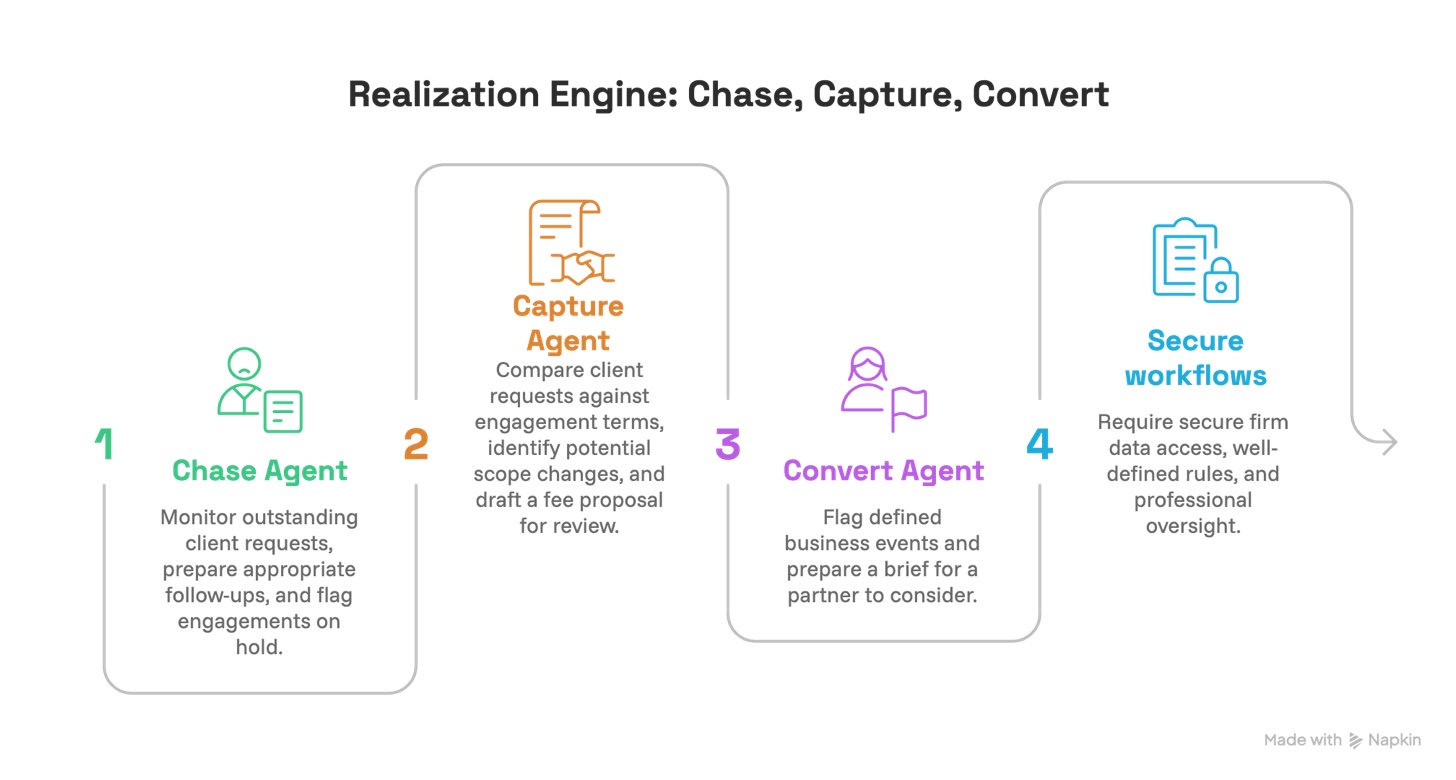
At Afrex AI, we’ve been developing an approach called the Realization Engine, built around Chase, Capture, and Convert.
The idea is to support the operational work that often consumes valuable staff and partner time.
A Chase Agent could monitor outstanding client requests, prepare appropriate follow-ups, and flag engagements that remain on hold.
A Capture Agent could compare client requests against engagement terms, identify potential scope changes, and draft a fee proposal for review.
A Convert Agent could flag defined business events and prepare a brief for a partner to consider.
These workflows require secure access to the appropriate firm data, well-defined rules, and professional oversight.
They don’t replace tax judgment, quality control, or client relationship management.
They give your team better visibility and reduce the amount of routine administrative follow-up required to keep engagements moving.
Your Firm’s Institutional Knowledge Is Part of the Solution
There’s another operational challenge worth addressing.
Most CPA firms have a wealth of institutional knowledge.
The problem is where that knowledge lives.
Some of it is in documented SOPs.
Some is buried in prior-year workpapers and review notes.
Some lives in email conversations.
And some exists entirely in the minds of partners and senior managers.
We’ve been developing the concept of a Firm Brain, a centralized knowledge resource that makes approved procedures, templates, engagement rules, review standards, and common workflow answers easier to access.
Start with the questions your staff asks repeatedly.
Document the approved answers.
Link them to the appropriate procedures and templates.
Keep the information current as your firm’s processes change.
Over time, this becomes a valuable resource for onboarding staff, maintaining consistency, and reducing routine partner interruptions.
It also provides a stronger foundation for AI-assisted workflows.
Of course, access controls, confidentiality, review procedures, and professional judgment remain essential. A firm’s internal knowledge system should support established quality management practices, not bypass them.
What We Learned Working With a Law Firm
Although the Realization Engine approach is being developed for CPA firms, we’ve seen the value of operational improvements in another professional services environment.
Afrex AI worked with a veterans law firm that was managing client intake, communication, and business development across several disconnected tools.
We helped consolidate eight systems into a centralized operating environment.
According to the firm’s reported results, its sales and client re-engagement system generated $1.6 million in new revenue during the first year, with cumulative revenue from that system later reaching $2 million.
Monthly technology expenses also declined from approximately $10,000 to $3,000.
Those results are specific to that law firm, not a projection of what another practice will achieve.
We don’t yet have equivalent results from a CPA firm implementation.
But the experience reinforced an important lesson.
The way a professional services firm manages its workflows can have a meaningful effect on its operating performance.
You can watch the interview and see the system in action here:
Before You Add More Clients, Take a Closer Look at Your Existing Practice
There’s nothing wrong with wanting to grow your client base.
New engagements are an important part of building a successful accounting firm.
But growth becomes much harder to manage when the underlying practice workflows are already stretched.
Client information sits outstanding.
Unbilled time accumulates.
Engagement budgets are exceeded.
Advisory opportunities get overlooked.
Partners become the bottleneck for routine decisions.
These problems deserve attention before they become more expensive.
My challenge to CPA firm owners is simple.
Set aside 30 minutes this week and complete your Realization Snapshot.
Review your stalled engagements.
Look at the additional work your team is performing.
Identify clients who may benefit from a tax planning conversation.
Pay attention to the routine questions consuming your partners’ time.
You may discover opportunities to improve realization, protect staff capacity, and strengthen client relationships without immediately increasing headcount.
The next stage of your firm’s growth may come from making better use of the work, expertise, and client relationships you’ve already built.
And that’s worth investigating before spending another dollar acquiring clients.
A Question for CPA Firm Owners
I’m curious about what you’re experiencing inside your practice.
Where do you see the biggest operational challenge today?
Is it collecting client documents, managing scope creep, controlling WIP and write-offs, expanding advisory services, or freeing up partner capacity?
I’d love to hear your perspective in the comments.
And for firms interested in identifying where revenue may be getting stuck, we’ve created a short Money Stuck assessment.
I’m Christina Beckford, founder of Afrex AI. We help professional service firms improve their operations through AI, automation, and practical business systems. I write about the real opportunities and challenges that come with building more efficient businesses.