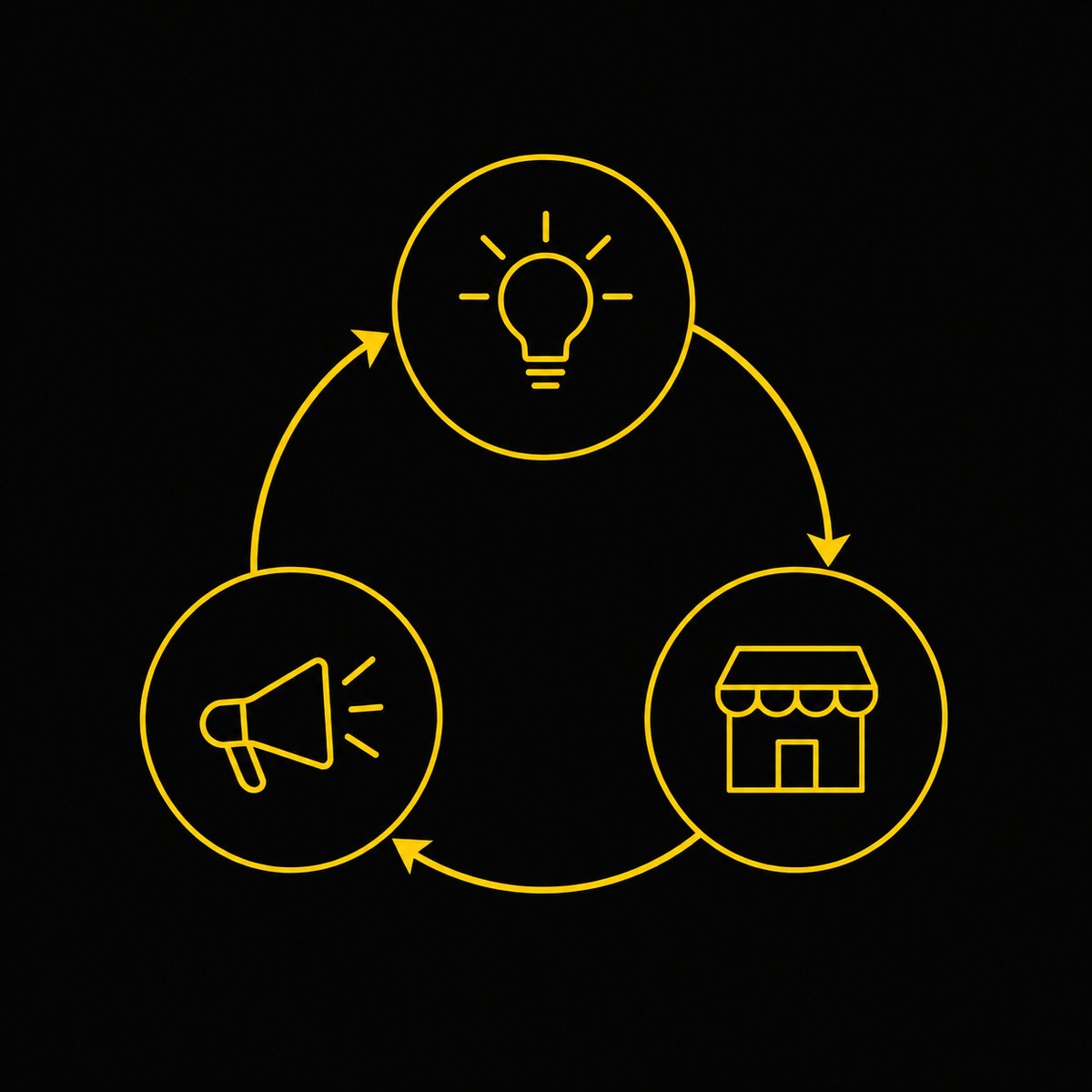
Strip a business back far enough and it does three things on repeat. It makes something worth buying. It puts that thing where people can buy it. And it brings people to the place where they buy.
Our view is that each of those three can be an automation. At minimum, a business is those three automations running together.
The three automations
1. Make the ideas. This is generation. It produces the thing you sell: a product, a design, a piece of writing, an offer.
2. Put them on sale. This is distribution, and it is where the sale happens. It takes what the first automation made and puts it in front of a buyer with a way to pay.
3. Bring people to the sale. This is marketing. Its only job is to send people to the second automation.
The first two are the product and the sale. The third is marketing, and it feeds the second. Take any one away and the other two stall. With no ideas there is nothing new to sell. With no place to buy, the ideas earn nothing. With no marketing, the shop is open but nobody walks in.
A worked example
Picture a small brand that sells illustrated books. This is an illustration of the shape, not a result we have measured.
Automation 1 drafts new book ideas for the brand every day. It also makes the covers, the logo and a consistent look, so every book belongs on the same shelf.
Automation 2 publishes each finished book to a self-publishing platform that prints on demand. When someone buys, the platform prints and ships the copy. The sale happens there.
Automation 3 is a daily scheduled job that posts to every one of the brand's social accounts and points people to the books.
That gives the brand two independent platforms: one where it sells, and one where it markets. None of the three needs to be clever on its own. What matters is that each one hands its output to the next, every day.
The minimum: one wheel that turns on its own
The bar we set is at least one flywheel where all three automations run together, without anyone pushing them. Ideas get made, put on sale and marketed, end to end, on their own.
We like to call each full wheel a franchise, half as a joke. A wheel earns the name once it has run end to end at least once on each of its two independent platforms. One is where it sells. The other is where it markets, however many social accounts and networks that covers. Until then it is a plan, not a franchise. You need at least one. Every franchise after that is a choice, not a requirement.
Once that first wheel is turning, the rest of the work can stay gated or in progress. A new step can wait for a person to approve it. Another can be the one you are still building. Their purpose is to keep improving that one wheel: better ideas, a smoother sale, marketing that reaches the right people. When you trust a step that still waits for a human yes, remove that gate. Then it turns on its own too.
That is the flywheel. One wheel runs on its own, and every improvement makes it turn a little faster. The work moves from doing the business by hand to improving a business that runs.
Why we think about it this way
It shows where the business is stuck. If sales are flat, the three automations tell you where to look. Is nothing new being made, is it hard to buy, or is nobody arriving?
It is easy to check. For each automation you can ask one plain question: did it run today? A yes or a no is easier to act on than a feeling that things are slow.
It tells you what to automate first. You do not have to automate everything on day one. Start with the step that takes the most hours, then connect the other two until one full wheel runs on its own.
What it does not solve
Running on its own is not the same as running well. Ideas made by a machine still need someone to check, after the fact, that they are good enough to carry the brand's name.
The places you sell have their own rules. Some self-publishing platforms ask sellers to declare content made with AI, and the rules differ from one platform to the next. Check them before you automate the publishing step.
Marketing that posts every day without review can repeat itself, or say something the brand would not. A wheel that turns on its own still needs someone to watch where it is going.
And three automations do not guarantee sales. They make the business easier to run and easier to improve. Whether people want what it makes is still the real test.
What it means for a business
Ask one question: of the three, making, selling and bringing people in, which already runs without you? If none of them does, start with the one that takes the most of your time. If all three do, you have your first wheel. Now make it turn faster.
If you want help finding the first automation worth building, book a strategy call or start with our AI use case scorecard.